Our Support Programs
Strengthening Safety Culture in Companies
Methods, Programs, and Support Approach
Why is Fullmark a Leading Player in Support Programs?
Every year, nearly 600,000 workplace accidents are recorded in France—that’s one every 45 seconds. Despite procedures, training, and audits, these accidents continue to happen. Why? Because compliance alone is not enough to create a true safety culture.
This is the difference Fullmark helps companies make through its SMART-Safety© method. We support companies (from operators to the Executive Committee) in building a safety culture that lasts, embedded in daily practices and on-the-ground behaviors.
Building structured programs with clients to strengthen safety culture has been Fullmark’s core expertise for 40 years!
What is Safety Culture, Really?
It’s a question many organizations think they’ve answered. They have a risk assessment document, an HSE manager, and a safety policy signed by the CEO. And there you go—they think they have a “Safety Culture.”
But they don’t! They have a management system, and that is something completely different.
Safety culture is what happens when the HSE manager isn’t there. It’s the decision an operator makes under pressure at 5:55 PM, when the truck is waiting and the floor is wet. It’s the action a team leader takes (or doesn’t take) when they see a colleague taking a risk.
It doesn’t show up on a poster. It is built and reflected in daily behaviors.
Let's stop confusing the two
Compliance vs. Culture
Compliance answers one question: Are we following the rules? Culture answers another: Why do we really want to be safe?
This isn't just a philosophical detail. It's the difference between an organization whose frequency rate drops because people are reporting less... and an organization whose rate drops because it's producing fewer accidents.
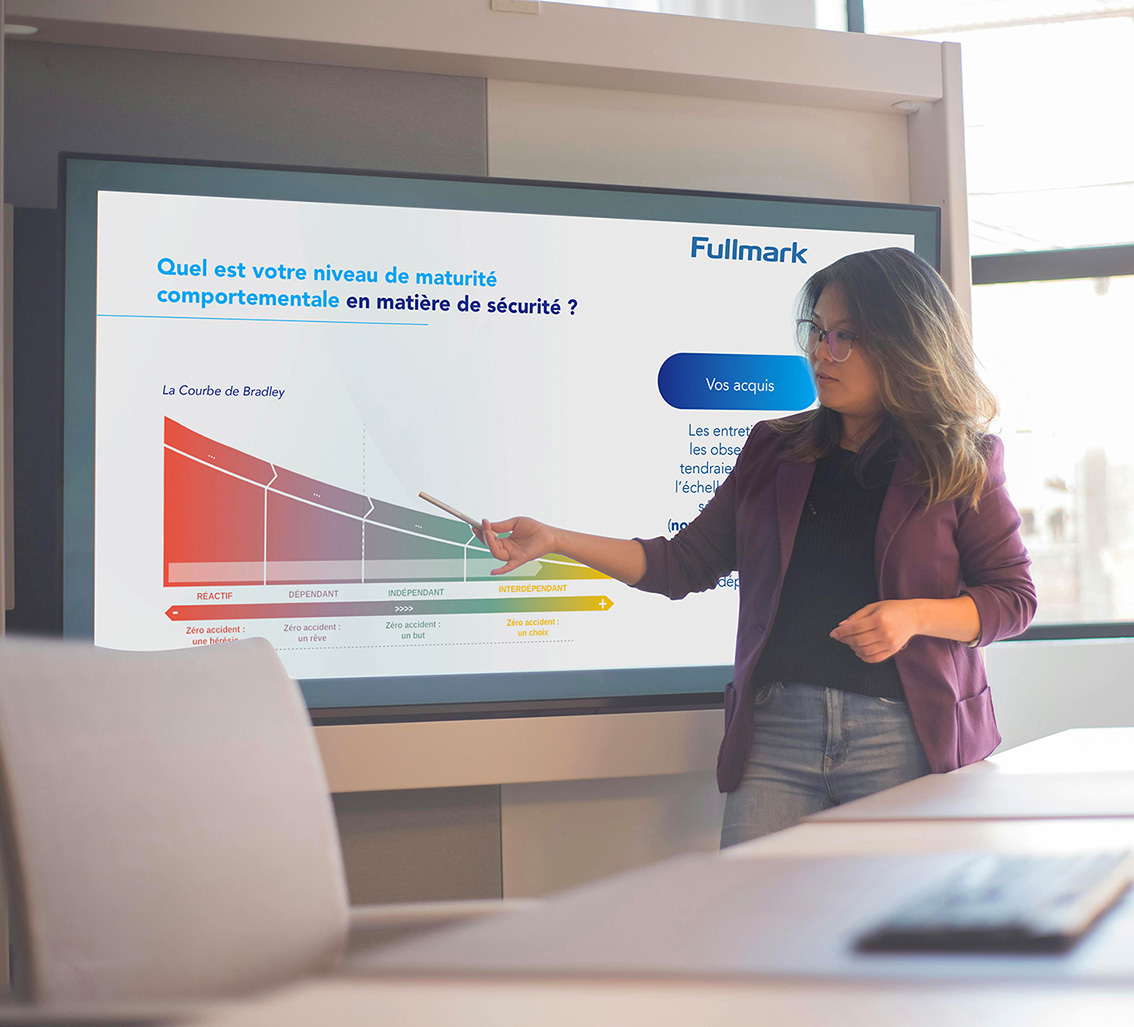
A Four-Step Progression
The 4 Maturity Levels: Where do you really stand?
There is a reference model in the field, often called the Bradley Curve or Hudson Scale. Four levels. Few organizations are honestly where they believe they are.
Fullmark’s SMART-Safety© programs are designed to move organizations from level to level in a structured, measurable way, without empty rhetoric.
The Observation No One Dares to Make
Why is Traditional Corporate Safety Training No Longer Enough?
Let's be honest: a one-day manual handling training session does not change a behaviour ingrained over ten years. Nobody would dare say it out loud in a board meeting. Everyone knows it.
Neuroscience has measured it: without spaced repetition, without contextual anchoring, without managerial support:
disappears within 48 hours
3 mechanisms explain the failure:
Not a training. A transformation programme.
That is why Fullmark built the SMART-Safety© approach: a multi-level method that combines structured programmes, field coaching, anchoring tools and measurement of real impact.
Developing a Sustainable Safety Culture
Methods That Work
40 years of interventions in diverse sectors such as construction, industry, agrifood, chemicals, energy, and logistics… have taught us: there is no universal method. But there are tested and fully proven methods.
In 80% of serious accidents, a deficit in safety leadership is found somewhere in the chain of command. This isn’t an accusation; it’s a lever. Safety Leadership is a shift in posture that is learned and perfected throughout a career.
Concretely, a manager practicing Safety Leadership does very specific things. They open every meeting with a safety point—not just a formality, but a real exchange. They go into the field to observe, not to police. When an operator reports a near-miss, they thank them publicly. And when production pressure mounts, they don’t compromise on safety. They say it. They show it.
Fullmark has trained over 20,000 managers in these practices: from frontline supervisors to the executive committee.
Our Programs

Twelve themes rolled out over the year, each with a poster, a facilitation resource and a digital version. Three campaigns available immediately: Shared Vigilance, Safety Essentials, Think Before You Act. Or a fully bespoke creation, aligned with your golden rules.
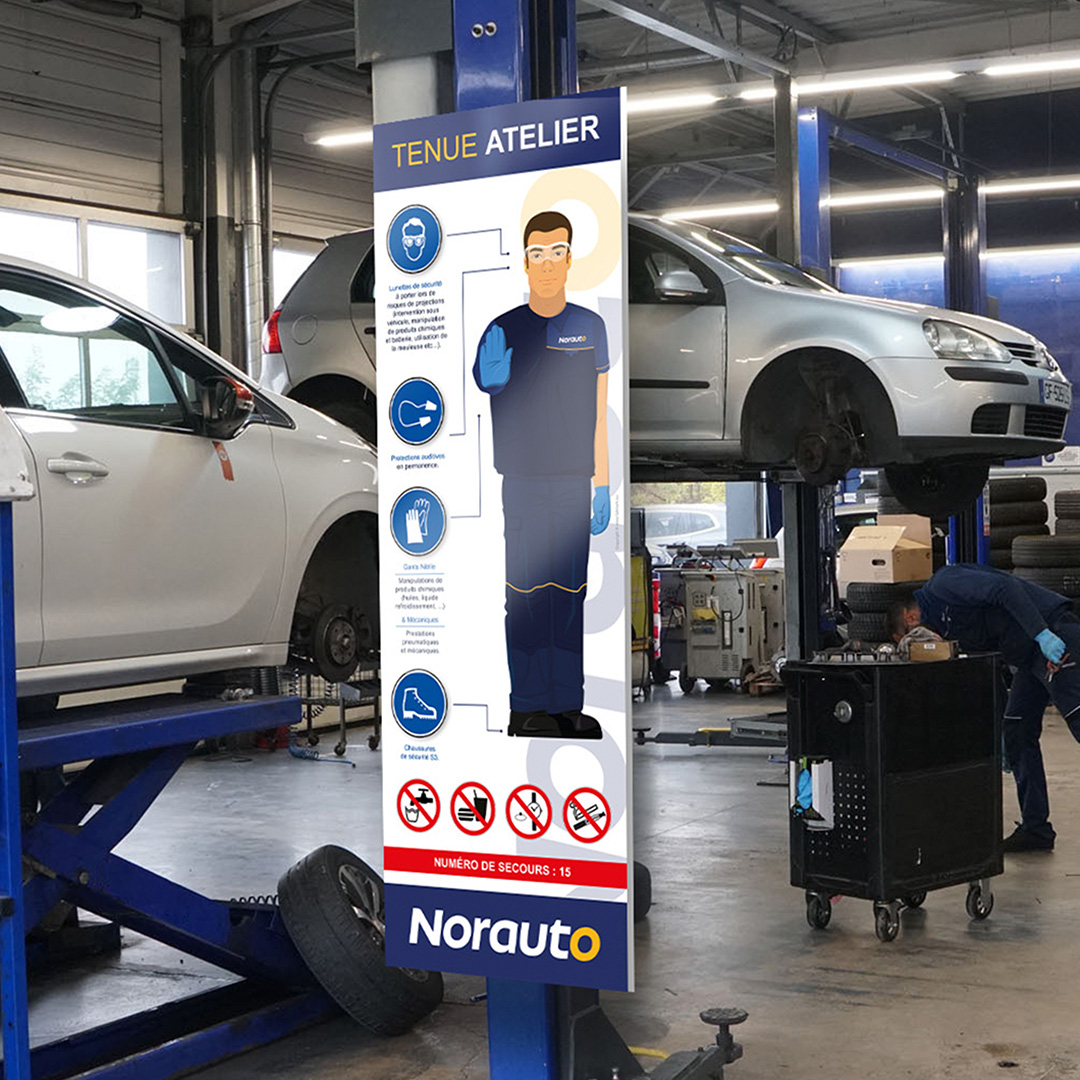
Striking visuals, a short slogan, a theme refreshed every month. Complemented by indicator boards (days without accidents, team commitments) that keep the message visible at all times.
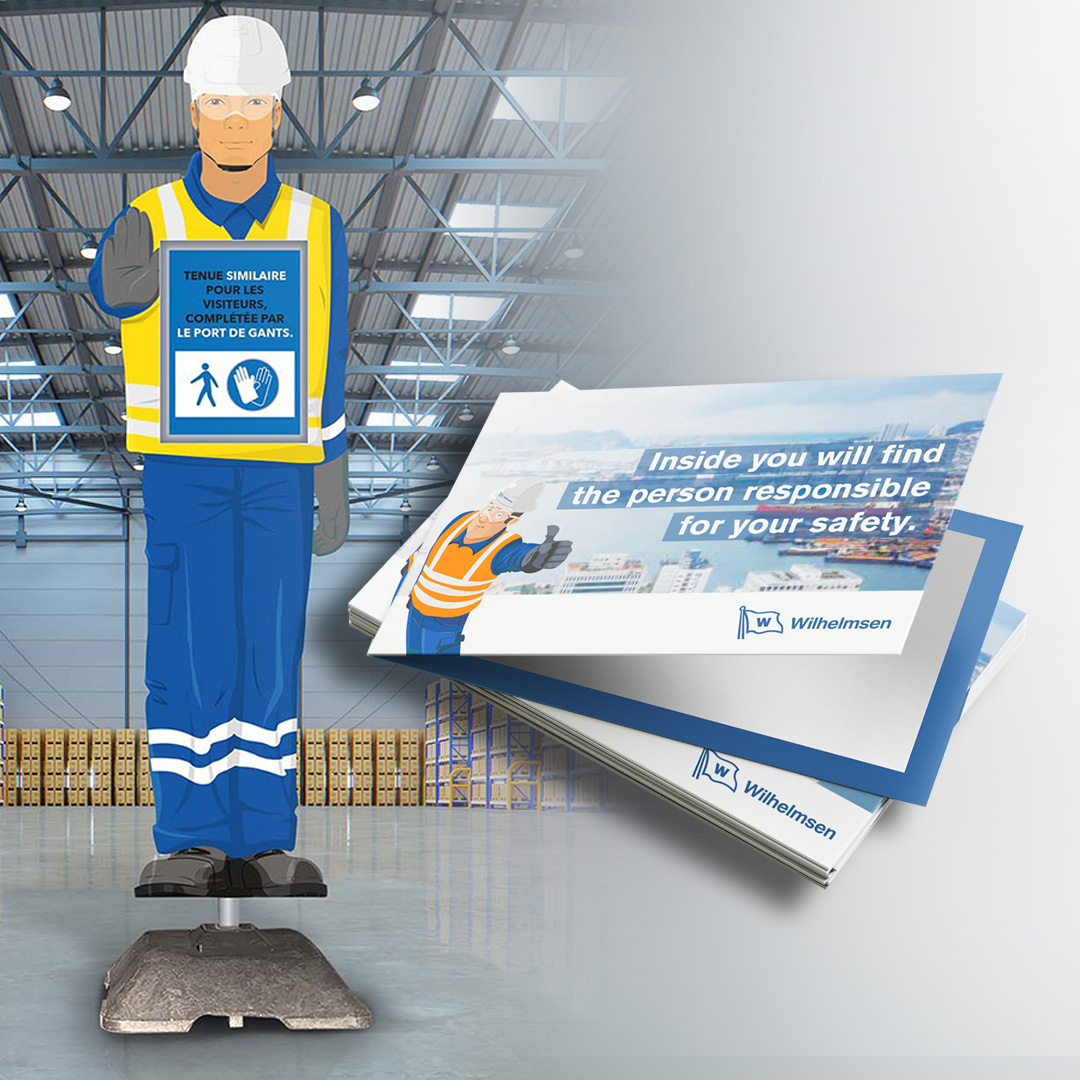
A recurring character, standing in a high-traffic area, that becomes a familiar landmark from one campaign to the next. And the mirror pouch — a message placed right next to the reflection, in the changing room.
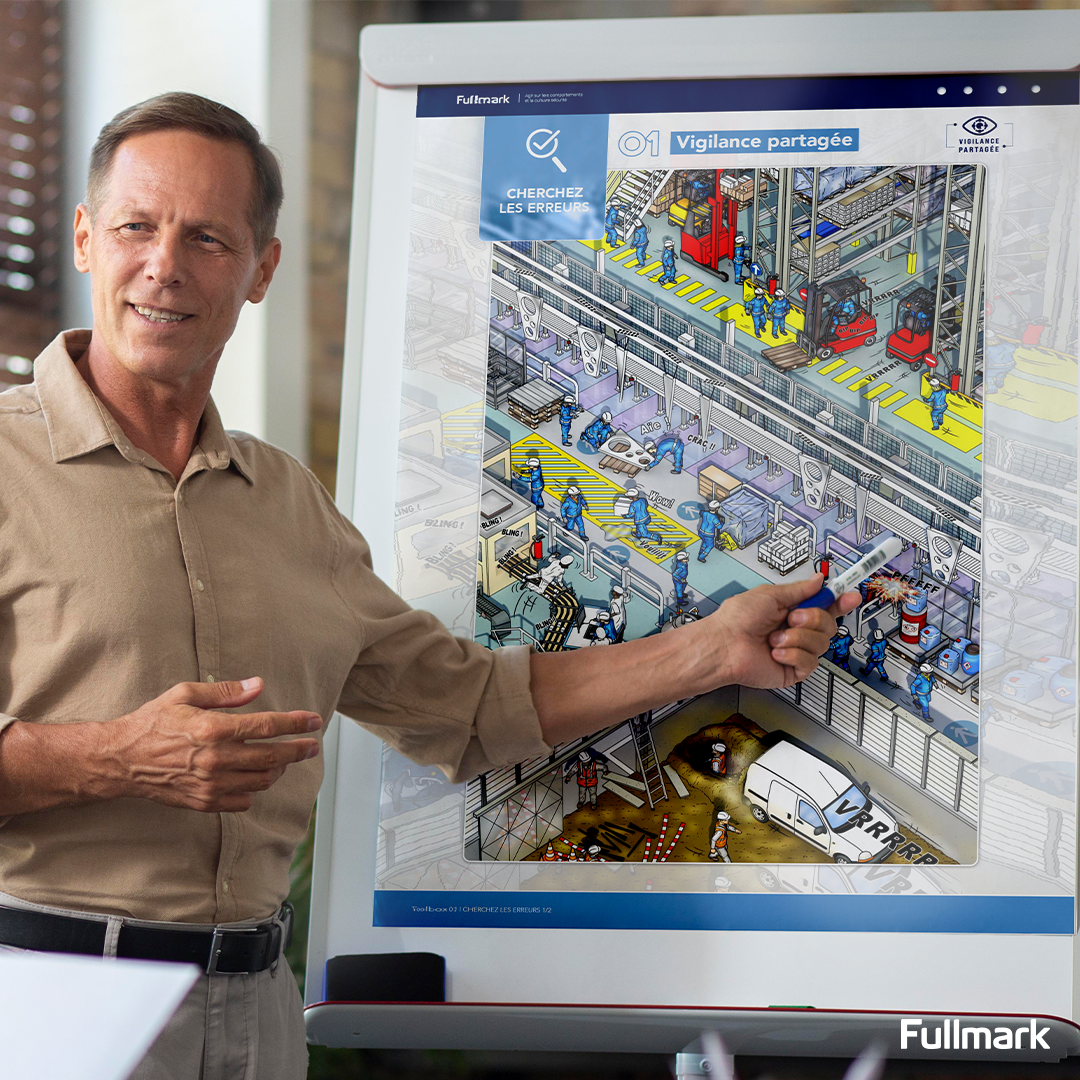
A board game, a safety comic strip, a spot-the-hazard sheet: formats that flip the dynamic — the teams themselves search for and find the right reflexes.
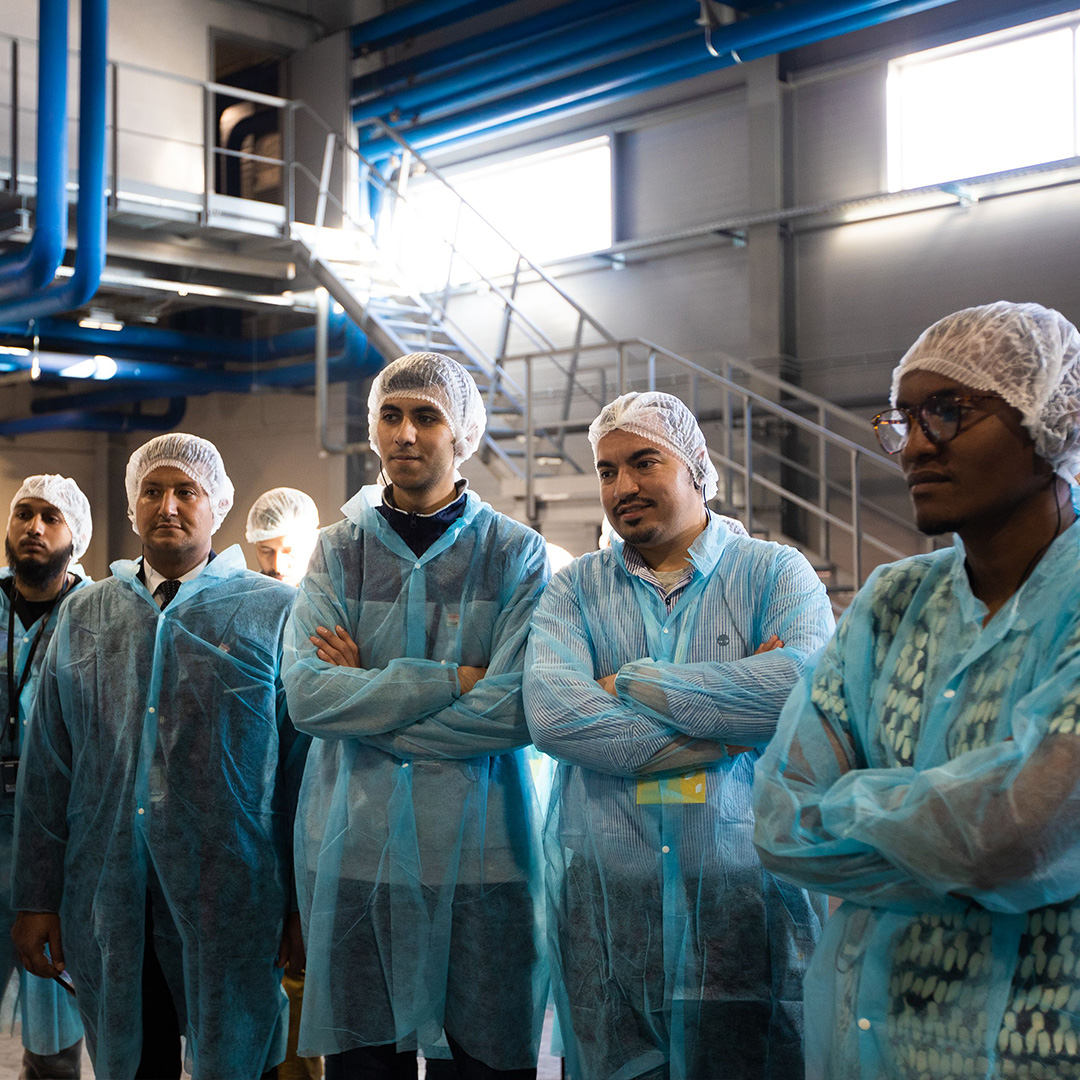
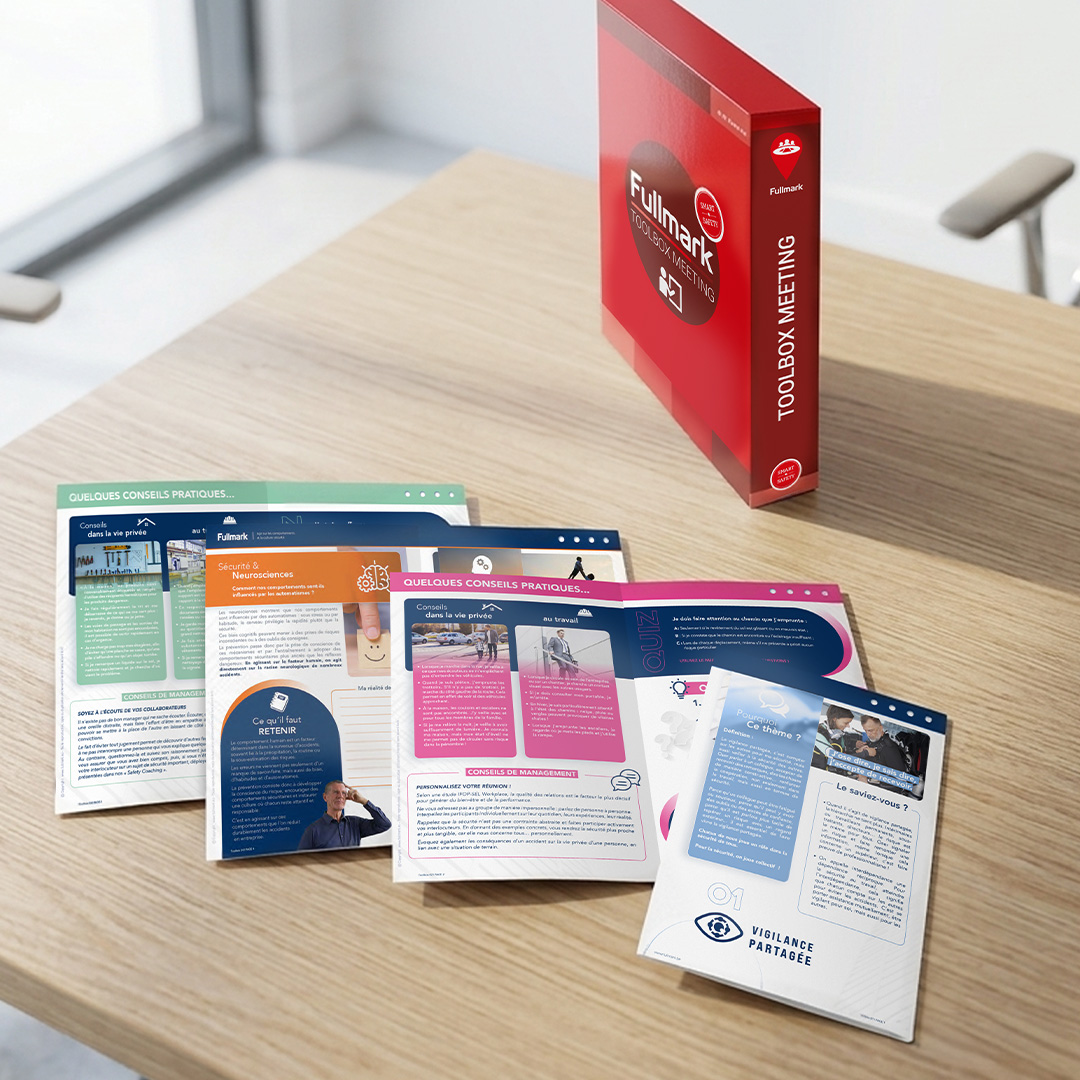
Ten to twenty minutes, led by the team leader, with a ready-to-use resource: a reflection question, a real-life case, a short video. The most underrated tool, and often the most effective.
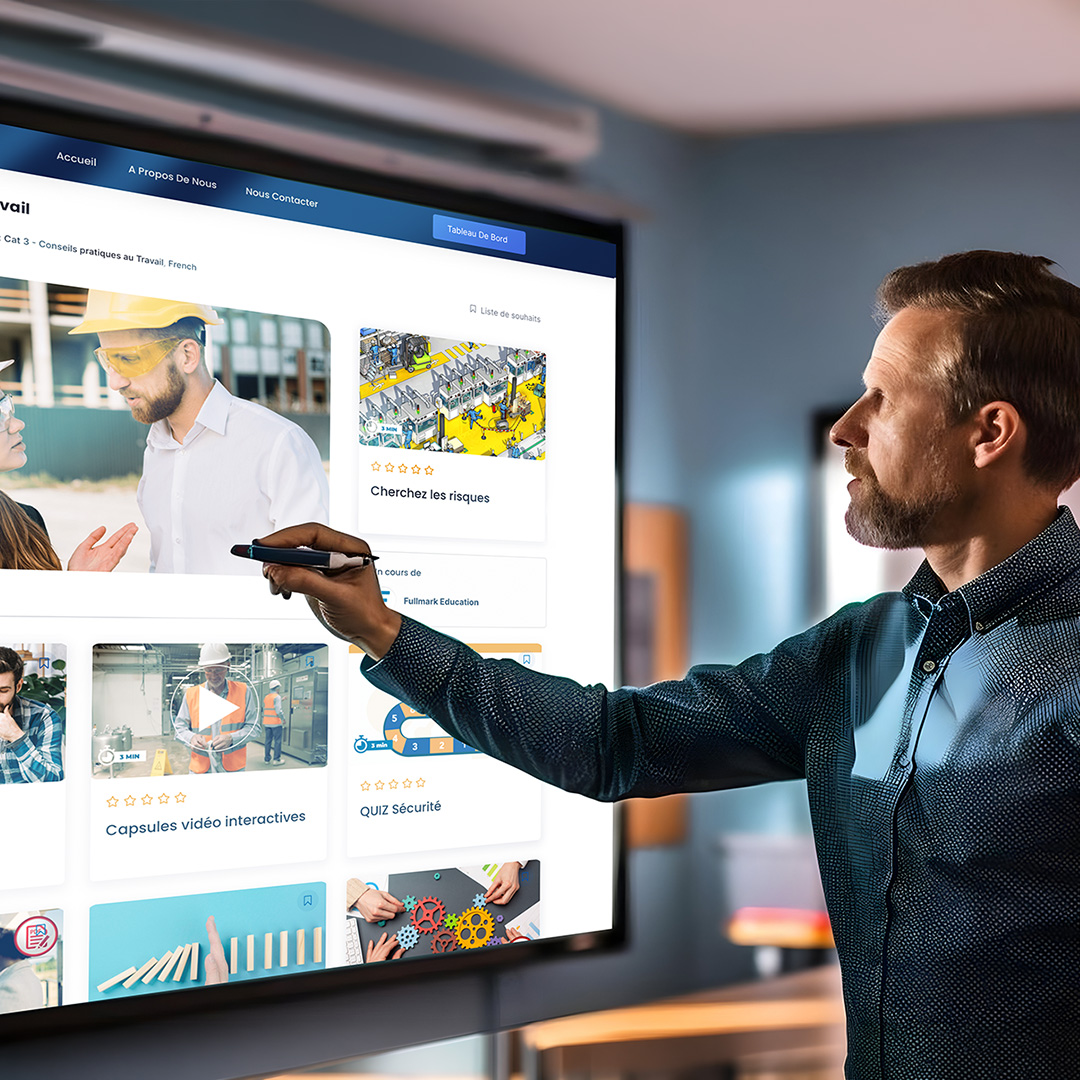
An interactive tool to run a safety briefing in a modern format, complemented by a broadcasting platform, e-learning and the Go5 app for 5 minutes of safety every day.

Before Choosing a Method, Know Where You Stand
The Safety Culture Diagnostic
Depending on your expectations and budgets, Fullmark has several approaches (survey-based, participatory, etc.) to conduct a diagnostic in your company. We offer a detailed analysis with real added value, and we always provide a proposed action plan and tools successfully deployed in other companies.
The mistake to avoid is launching a program before performing a diagnostic. For example, investing in Safety Leadership training when the real heart of the problem is a lack of field reporting.
The Fullmark Safety Culture Diagnostic combines:
- Measurement: Through the diagnostic, with a neutral external perspective, we place the marker somewhere on the safety culture maturity curve.
- Benchmarking: The diagnostic allows you to know where your company stands compared to other similar players.
- Transparency: Our experts provide a transparent view of how safety culture is perceived in your company.
- Objectivity: The diagnostic helps objectify beliefs regarding your safety culture.
- Major Risks: Our analysis identifies field practices that impact the management of major risks.
A Solid Safety Culture Starts with an Aligned Executive Committee
Executive Committee & Safety Culture
A safety culture isn’t built solely on regulatory obligations. For it to be sustainably embedded in practices, leadership involvement is essential.
That’s why Fullmark designed a journey dedicated to Executive Committees, focused on their posture, responsibilities, and role in developing a true safety culture.
Organized in half-day sessions and adaptable to each organization, the journey includes 7 modules.
Through role-playing, discussions, and concrete tools, participants leave with a shared vision and actions directly applicable in the field. The result: an aligned leadership, engaged teams, and a sustainable safety culture.
A shared language and the foundations of collective commitment
The concrete levers for anchoring safety within the organisation
A clear understanding of legal obligations and legal risks
The ability to deliver a message that truly convinces
Participative techniques to engage teams
How the brain works and how to influence behaviours
Robust action plans tailored to your context
Return On Investment
The Cost of Doing Nothing
The question is not “how much does a safety culture programme cost?”.
It is: “how much does the absence of a safety culture cost?”
to €50,000Average cost of a lost-time accident
Replacement, disruption, loss of productivity, administrative management.
Source: INRSIn some industrial sectors, the ratio rises to 1 for 6.
Source: ILOInvesting in safety culture is profitable. Not doing so has a cost.
From the First Meeting to Field Deployment
How Does it Work with Fullmark?
Before proposing anything, our experts carry out a genuine diagnostic: field observations, interviews at every level, analysis of your indicators.
On the basis of the diagnostic, we co-build your programme. Sector, size, sites, internal culture, operational constraints — everything counts. Multilingual available.
SMART-Safety programmes are delivered by expert trainers who know the field. Fullmark also offers Safety Days — powerful moments of collective engagement.
That is where most providers stop. Fullmark stays. Multi-year support, indicator tracking, Safety Steering Committee.
Methods, Programs, and Support Approach
Why Do Companies Like EDF, Lactalis, Danone, SNCF, or Total Choose Fullmark?
They could have chosen a large generalist consulting firm. They chose Fullmark. Why?
Not because we are the cheapest. Because we are the most effective on this specific subject.
Safety culture isn’t just a line in our catalog. It has been our only business for 40 years. We don’t have an HR division, no digital transformation hub, no strategic consulting team. We do this. Only this. And we do it well, with passion!
| What sets us apart | In practice |
|---|---|
40 years of experience | Several thousand companies supported. All sectors, all sizes. |
2,500 active clients | From process industries to services, from construction to healthcare. |
20,000 managers trained | From frontline supervisors to the CODIR: the full chain. |
Local & international presence | France, Belgium, the Netherlands, Spain. Multilingual programmes. |
40 expert trainers | Passionate specialists. Not generalist trainers repurposed for safety. |
Ready to Break Through the Glass Ceiling
of Your Safety Results?
Let’s discuss your specific situation and see which ideas, tools, concepts, and ideal program can help you meet your challenges in strengthening safety culture.
Frequently Asked Questions - FAQ
What is safety culture in a company?
Safety culture is the set of behaviors, attitudes, and values shared in an organization regarding risks. It's not a system, not a document. It's what people do when no one is watching. It is built over time through manager exemplarity, daily rituals, and structured programs like Fullmark's SMART-Safety©.
How to measure the maturity of an organization's safety culture?
Via three types of indicators. Reactive ones (Frequency Rate, Severity Rate) measure past failures. Proactive ones (rate of safe behaviors, reported near-misses) measure the ability to prevent. Cultural ones (level of trust, freedom to report) measure the deep state of the culture. The Fullmark Diagnostic combines all three with field observations and qualitative interviews.
What is the difference between safety culture and an OHS management system?
The management system (ISO 45001, etc.) is the framework. Culture is what happens outside the framework—spontaneous decisions, behaviors under pressure, the unspoken. One structures; the other drives. You can have the best management system in the world and a disastrous safety culture. The reverse is also true.
Why is traditional safety training not enough?
Because they transmit knowledge, not reflexes. Without repetition, contextual anchoring, and managerial support, 80% of content is forgotten within 48 hours. Isolated training does not change behavior. A program (with field coaching, regular feedback, and managerial exemplarity) is what changes it.
What is safety leadership?
It is a manager's ability to influence their team's safety behaviors through their own actions. Not their speeches, but their actions. Field visits, safety briefings that are truly engaging, valuing reports, and absolute exemplarity when production pressure mounts. Fullmark trains managers in these concrete practices through its Safety Coaching programs.
What is BBS (Behavior-Based Safety)?
A method that reverses usual logic: instead of counting accidents, we measure behaviors. Trained observers, often peers, conduct structured field observations and provide constructive feedback. The data feeds into a collective action plan. Result: we act on causes, not consequences.
How to involve frontline managers in safety culture?
By equipping them, not just training them. They need practical tools (safety briefings, structured field visits), coaching to help them shift their posture, and recognition of their role in managerial evaluations. Fullmark offers dedicated programs—Safety Coaching, individual coaching, Executive Committee support—for every level of management.
How long does it take to change a company's safety culture?
Between 18 and 36 months for sustainable anchoring. The first positive signals often appear within the first 6 months: behaviors, climate, proactive indicators. But deep cultural change is built over the long term. That's why Fullmark's support is designed to last, with regular evaluations and continuous adjustments.