
Cause Tree Analysis

Giving meaning to the "safety" concept and reinforcing leadership.
Objectives: Learn how to build a cause tree and identify actionable causes. What are the unsafe actions? What are the hazardous situations? Learn how to communicate factually about an accident. Know how to reframe discussions during cause tree development when straying from the facts. And ultimately, do everything possible to prevent recurrence!
Topics covered:
- Non-judgmental listing of accident facts (Technical, organizational, behavioral)
- DESC reframing technique (introduction to the communication tool and hands-on practice throughout the day)
- Reframing role plays.
- Reliability cause tree exercise
- SVP tool (did the person not know, could not, or would not?)
- Small group exercise: cause tree analysis of a personal injury accident and presentation of findings.
Target skills: We will provide your managers with new resources and tools to better help them optimize safety leadership and their overall leadership capabilities.
While zero risk does not exist in the workplace, a business leader’s ongoing objective is to prevent and anticipate incidents. But how should you respond after the fact, to calmly ensure that an unfortunate event does not recur? The answer lies in a method that explores every avenue…
Analyze
Identify the root causes of an incident rather than treating only its symptoms.
Involve
A collaborative, open approach that gives every stakeholder a voice.
Prevent
Turn every incident into a driver for sustainable safety improvement.

Quantity or quality: which branch should you choose?
For numbers not to lie, studies and statistics must span across time to record, track, and compare post-incident data. This quantitative method provides an overall view of risks and helps establish general prevention priorities. However, mathematical data yields numbers and categories, but fails to reveal root causes or the chain of events leading to an accident. Because relevant conclusions and tailored action plans require an in-depth analysis of context, facts, and testimonies, the qualitative method emerged in the 1970s, popularized by the INRS. A practical investigative approach known as the “cause tree,” which takes root in the field and grows through open dialogue…

What is a cause tree?
The cause tree, or incident tree, is a practical tool designed to analyze the underlying causes of an incident or any other unwanted event detrimental to workplace safety.
In practice, it is a tree diagram that methodically and rigorously visualizes the various causal factors that led to a specific incident.
Based on the premise that an incident results from multiple dysfunctions, the cause tree method takes a systemic view (the big picture) to explore the various contributing factors (components) and how they interacted to cause the final event.

Why use a cause tree?
The cause tree method investigates accident factors well upstream of the immediate work situation or worker behavior. Rather than simply recording the facts immediately surrounding the injury (at Time T), it examines work organization right down to overall company operations.
Through qualitative analysis, the cause tree seeks to engage all employees by establishing an open, honest dialogue. Unlike dry statistics, this collective discussion prioritizes words over numbers.
With the cause tree, the process does not look for someone to blame; instead, it generates constructive solutions to prevent future accidents, making communication fertile ground for progress.
Moreover, made readily accessible and easy to understand through its graphical format, the cause tree serves on its own as a clear, transparent communication tool for everyone. This apparent simplicity reflects a commitment to uniting teams around safety, making a core element of safety culture accessible without downplaying its importance. After all, isn’t a picture sometimes worth a thousand words?
How do you build a cause tree?

Select capable, objective, and engaged team members. This should include individuals directly linked to the incident, others valued for their analytical or interpersonal skills, and a decision-maker empowered to implement the necessary corrective measures.
Collecting facts is the most critical stage in developing a cause tree. It must therefore be thorough, accurate, and comprehensive.
Almost immediately after the accident, facts should be sorted into two categories:
These interviews reveal various perspectives on the incident (technical, human, organizational), which will subsequently broaden prevention and awareness initiatives.
Important: Only concrete facts must be retained, separating out emotions, interpretations, or personal opinions. Use straightforward terms so that everyone can understand and recognize them.
With all the facts in hand, it is time to develop your diagram.
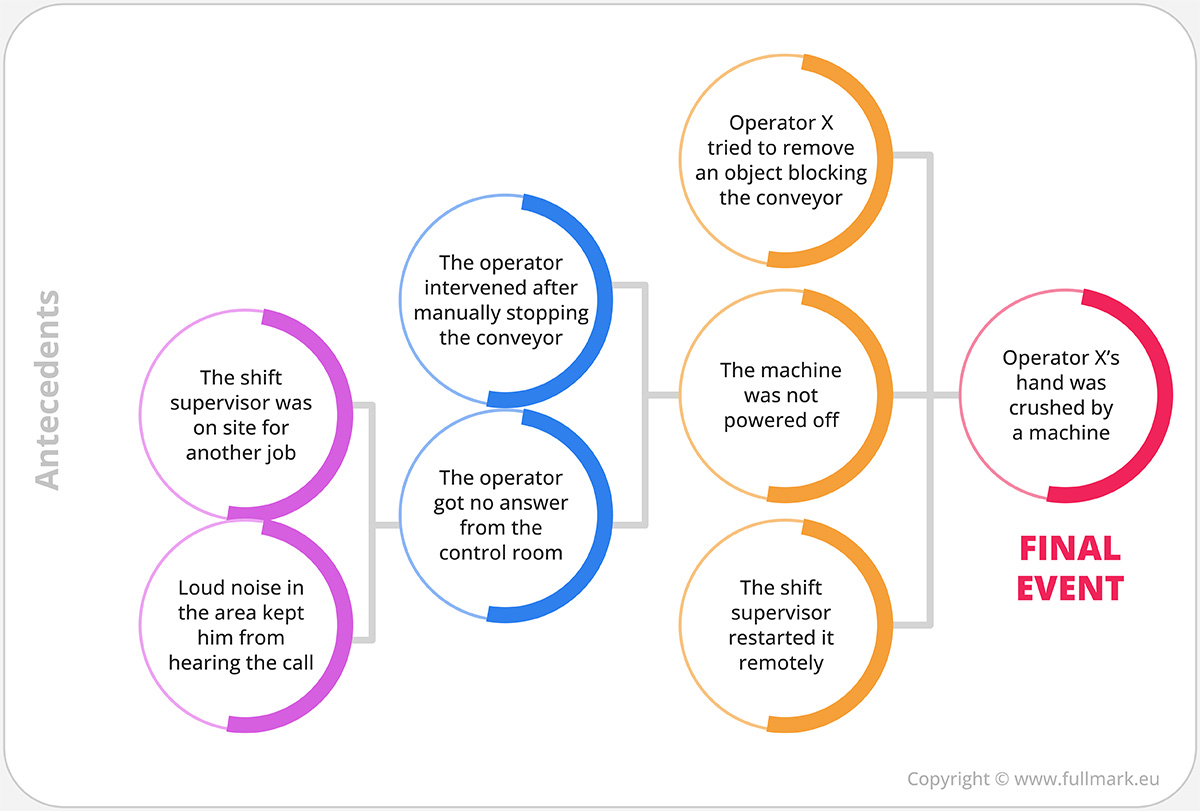
The tree is built retrospectively. Starting from the ultimate event (the accident), facts are positioned relative to one another iteratively, working backwards from consequence to cause. The incident is the tree's starting point; permanent conditions or unusual facts (variations) form its branching lines. Antecedent facts consistently answer the same questions:
Why did this occur? • Were there other contributing factors?
Ultimate Event
Operator X had their hand crushed by a machine.
Why did this occur?
Operator X tried to remove an object jamming the conveyor belt.
Were there other contributing factors?
The shift supervisor restarted the line remotely. (Unusual fact)
The machine was not powered off. (Permanent condition)
Why did this occur?
The operator intervened after manually stopping the conveyor. (Unusual fact)
The operator received no response from the control room. (Unusual fact)
Why did this occur?
The shift supervisor was attending to another intervention on site. (Unusual fact)
High background noise in the area prevented hearing the call. (Permanent condition)
Were there other contributing factors?
etc.
Without presuming fault and following an objective review of facts and circumstances, building this cause tree swiftly uncovers the operational breakdowns: failure to follow instructions (operator), poor communication (shift supervisor), questionable staffing management, and insufficient information on machine risks.

The ripple effect: butterfly facts.
Facts can be linked together through three types of relationships:
- Sequence: one activity triggers another,
- Conjunction: an event occurs as a result of multiple antecedent facts combined,
- Disjunction: a single antecedent fact leads to several distinct consequences.
While terminology may vary depending on the framework, cause trees know no practical limits to their expansion. That is precisely the value of this method: being able to deconstruct any situation at will, identifying hidden causes and influences to implement comprehensive prevention.


Cause trees and prevention: the common core.
Post-cause tree improvement and prevention work also requires setting up a multidisciplinary team. The goal is to provide solutions for every identified fact, regardless of its position in the tree. Both immediate causes and upstream factors must be addressed to enhance overall safety conditions.
Very often, clear-sighted analysis shows that implementing standard preventive measures (PPE, training, instructions) is enough to prevent incident recurrence. In other words, sawing off one or more branches directly linked to the ultimate event eliminates the risk.
However, thorough application of the methodology highlights far more diverse levers for action, touching on root causes and broad measures that are the responsibility of senior management.
This holistic view of potential risks and peripheral issues is made possible by the structure of the tree itself, rewarding detailed and comprehensive investigative work.
To facilitate this forward-looking analysis, the “ITAMAMI” method categorizes the following dimensions:
I: Individual
T: Task (or A: Activity)
MA: Material / Equipment
MI: Environment (Milieu)
Classifying collected facts into these corresponding categories provides greater clarity and visibility, saving time when defining short-term improvements.
Furthermore, specific facts observed in an isolated situation can take on wider strategic significance when viewed from a broader perspective.
The organization can then implement corrective or preventive actions for the specific incident, as well as across other operational contexts where an identical risk exists.
A way to ensure you don’t miss the forest for the trees, in short…

Cause tree analysis and safety culture.
The qualitative approach, or cause tree analysis, offers strong appeal thanks to its practical, concise methodology.
However, reaching the top requires several prerequisites, starting with genuine commitment from site leadership. As noted, collecting facts and eyewitness accounts is essential to building an incident tree. To ensure everyone’s cooperation and integrity, managers must reassure their teams: the goal is never to assign blame, but to establish a body of evidence against hazardous situations.
Management’s commitment is also reflected in training investigators; the staff comprising the investigation team must be skilled and knowledgeable about current regulations (confidentiality, formal procedures, etc.).
It is good practice to inform all personnel about the framework in place and its goals: improved working conditions, fewer accidents, and proactive prevention.
Ideally, any significant improvements and successes resulting from the cause tree method should be widely communicated to staff, reinforcing employees’ day-to-day role as active safety observers and contributors.
After all, isn’t a tree known by its fruit?


