
Professional Training
Leadership & Safety
Invest in your future with safety leadership training and transform your managers into true safety champions!
Thanks to this innovative program, your leaders will be better equipped to build a strong, proactive safety culture within their teams.
The strengths of the training
-
Giving meaning to safety
In-depth reflection will help give real meaning to safety rules and procedures -
Integrating safety into every aspect of work
The training gives managers the skills they need to integrate safety into every aspect of work. -
Fostering accountability and shared vigilance
Managers learn techniques to inspire a culture of accountability and shared vigilance. -
Reducing risks
Participants will gain essential skills to identify and mitigate risks, particularly by strengthening communication and collaboration. -
Leading by example, engagement, and productivity
By adopting exemplary safety practices, your managers will inspire trust and engagement, reducing accidents and increasing productivity. -
Excellence
Through this training, you give your teams the leadership they need to excel safely.

Learning Materials
The new training
"Roadbook"!
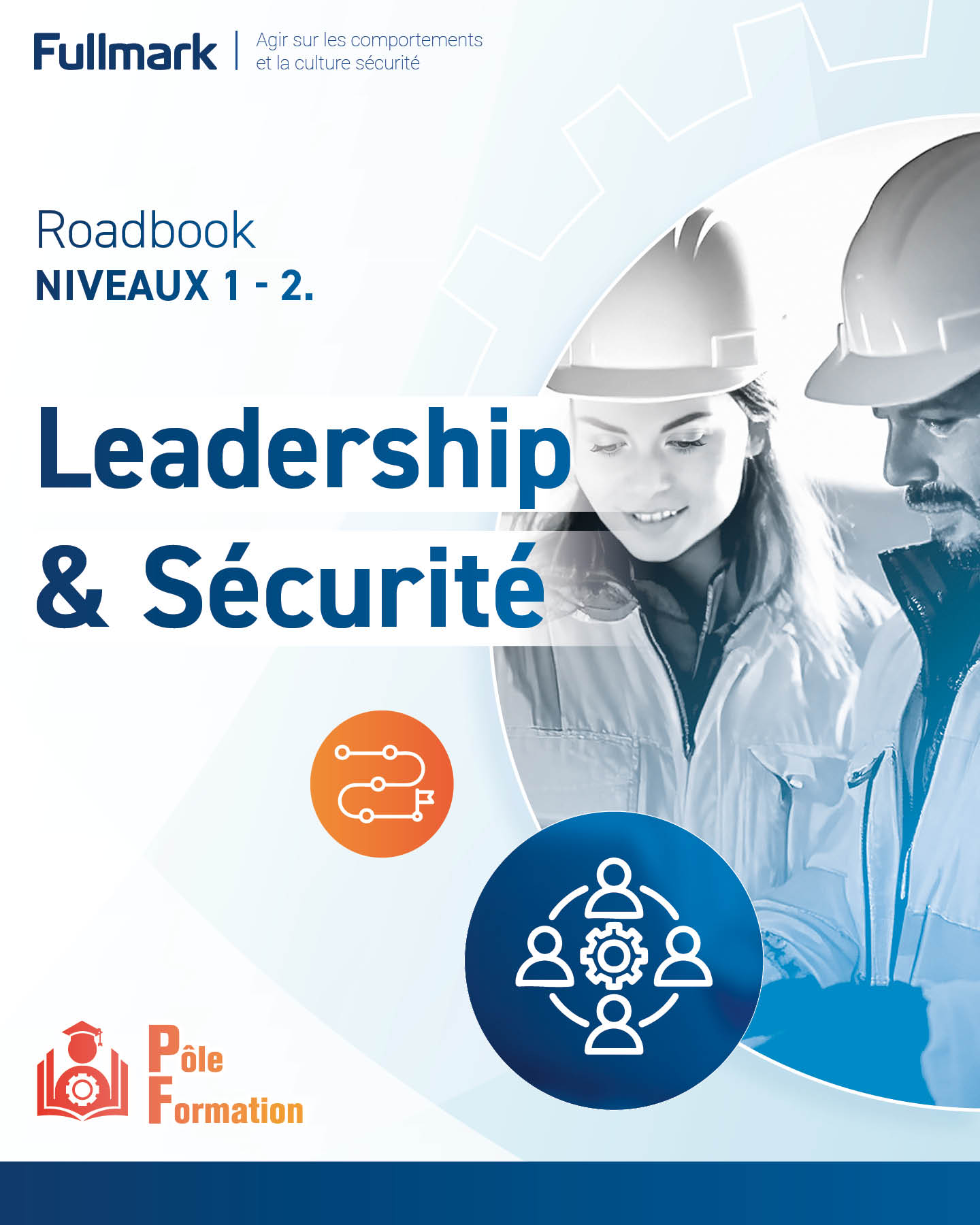
This module comes with a “Roadbook” written in a modern, illustrated style.
- It is used during the training to carry out hands-on exercises.
- It allows each participant to extend and deepen their learning through numerous techniques that can be directly applied in the field.
- The new “Roadbooks” that accompany our trainings are probably the best learning materials available today!
Frequently Asked Questions - FAQ
What value does this training add for me as a manager?
This training will help you develop essential safety leadership skills, strengthening your ability to manage risks, improve communication, and create a safer, more productive work environment.
What concrete results can I expect after completing this training?
You will see a reduction in safety incidents, stronger team adherence to safety protocols, and increased productivity thanks to a safer, more collaborative work environment.
How long will this training take, and does it fit into my busy schedule?
This training module is structured to be delivered in one day. Fullmark also offers various complementary modules covering topics such as neuroscience or communication techniques.
How can this training benefit my company as a whole?
By training your managers in safety leadership, you strengthen your company's safety culture, reduce costs related to accidents, improve employee satisfaction, and increase overall company performance. In addition, the leadership techniques developed during the training are naturally useful in every area where a leader must collaborate with their team, far beyond safety alone.
Are there testimonials or case studies available?
Yes, we have numerous client testimonials on this page of our site: https://www.fullmark.fr/fr/81-temoignages-campagne-securite.html Our clients describe the significant improvements in safety and performance achieved through this training. We especially invite you to watch this video testimonial: https://www.fullmark.fr/fr/812-temoignages-video.html.

How can you engage employees in their work and in following safety rules?
Developing your leadership
Fullmark’s exclusive approach will help participants acquire skills such as active listening, powerful questioning, and feedback management. You will be amazed at the difference in impact between correcting someone “on the fly” and correcting them while following a few simple rules. Proper correction can truly change bad behaviors… for the long term!
Clearly communicating expectations and goals
Even though learning communication techniques is covered in a separate training module (available via this link: https://www.fullmark.fr/fr/25102-formation-techniques-communication.html), this Safety Leadership module will ensure that every manager sets clear goals and makes sure everyone understands how to act to achieve them.
Creating an environment of trust and respect
In addition to practicing active listening (particularly by listening to employees’ concerns and suggestions), a good leader will embody the values of respect and recognition. They will know how to properly recognize and appreciate their team members’ efforts and achievements.
Encouraging participation and engagement
Through the exchanges and discussions that take place among participants in this interactive training module, you will learn how to involve your employees in decision-making processes specific to your organization, especially, of course, those related to their work and safety.
We will also see that a good manager-leader is able to give each person clear responsibilities and the autonomy needed to accomplish their work.
Training and raising awareness continuously
This has obviously been Fullmark’s guiding principle for 40 years! We know that safety you don’t see isn’t safety you live by! That’s why it’s essential to regularly reinforce safety rules in order to maintain safety awareness.

Modeling the expected behavior
We advise leaders to adopt the behaviors and attitudes they want to see in their employees. This is obviously very important when it comes to following safety rules. To be credible, a leader must absolutely lead by example by strictly following all of the company’s safety rules.
Providing constructive feedback
Beyond mastering the art of effective correction, a leader must also give regular, constructive feedback to team members to help each employee continuously improve. We have found that managers tend to use positive reinforcement—highlighting good behaviors—far too little. Yet the need to be recognized, like the need for esteem and personal accomplishment, sits at the top of Maslow’s famous hierarchy of needs. We will see that recognition doesn’t have to be purely financial.
It is therefore useful and necessary to publicly commend employees who demonstrate excellent compliance with safety rules and strong engagement.



Recognition and positive feedback
The trap of the “watering can” approach
Even when the intention is good, compliments given in general terms and addressed to everyone at once often fail to please. In the worst case, they can even demotivate employees.
There’s nothing wrong with praising a team, a division, or an entire company, but if not a single positive remark has been made throughout the year, compliments handed out at an annual meeting will fall flat and seem out of place, coming across as a mere formality—a matter of decorum.
How to give praise individually?
The better you know your staff, the easier it will be to give them tailored feedback. This means:
Adjusting frequency
It’s important to respect the fact that some employees need little or no praise. The approach that suits them best is being commended during their annual performance review, one on one. They respond best to well-founded, objective arguments based on their performance. They often find it unpleasant to be praised frequently, in front of others, for work they consider normal and simply part of their job description.
Other people truly thrive when their manager regularly takes an interest in them and gives them positive feedback. Adapting your approach to giving praise here means taking advantage of official occasions while also being generous with compliments day to day—when they’re deserved, of course.
Specific and concrete rather than general and abstract
What truly matters to employees is that their manager genuinely talks about them and their specific performance.
Vague phrases that don’t say anything very precise, such as “I’m very satisfied with your work and your commitment. Keep it up,” are certainly pleasant to hear and surely well-intentioned. But the recipient can’t do much with them. The compliment is phrased in a general, abstract way and isn’t addressed specifically to the person. It’s an empty formula that could be given to any other employee. For your words to be taken seriously and well received, they must be neither interchangeable nor too vague.
As a manager, the better you are at evaluating the quality of the work accomplished and what it actually means for each employee, the easier it will be for you to give targeted, personal compliments.

Should safety be a priority or a value?
Priorities change and shift significantly over time, whereas a value shapes everything you do in a far more lasting way, forming the company’s culture. We therefore believe that safety should not be a priority for companies, but a value! Values should not be confused with short- or medium-term economic objectives. The values put forward are shared by everyone, uniting the men and women who make up the company. Values must be reflected in the way the company is governed—that is, in its actions and behaviors.


