
Safety diagnosis
SMART-Safety Consulting
Why carry out a safety culture diagnosis?
- Measurement: Through the diagnostic, with a neutral external perspective, we place the marker somewhere on the safety culture maturity curve.
- Benchmark: the diagnosis lets you see where your company stands compared to other similar organizations. Is the level of safety culture in your organization “world-class”?
- Transparency: Our experts provide a transparent view of how safety culture is perceived in your company.
- Objectivity: The diagnostic helps objectify beliefs regarding your safety culture.
- Major Risks: Our analysis identifies field practices that impact the management of major risks.

Depending on your expectations and budget, Fullmark offers several solutions and approaches for carrying out a diagnosis within your company. Whichever approach you choose, we certainly don’t just confirm what you already know! We provide you with an in-depth analysis with real added value, and we always deliver a proposed action plan along with tools that have been successfully implemented in other companies.
Solution 1:
The participatory diagnosis

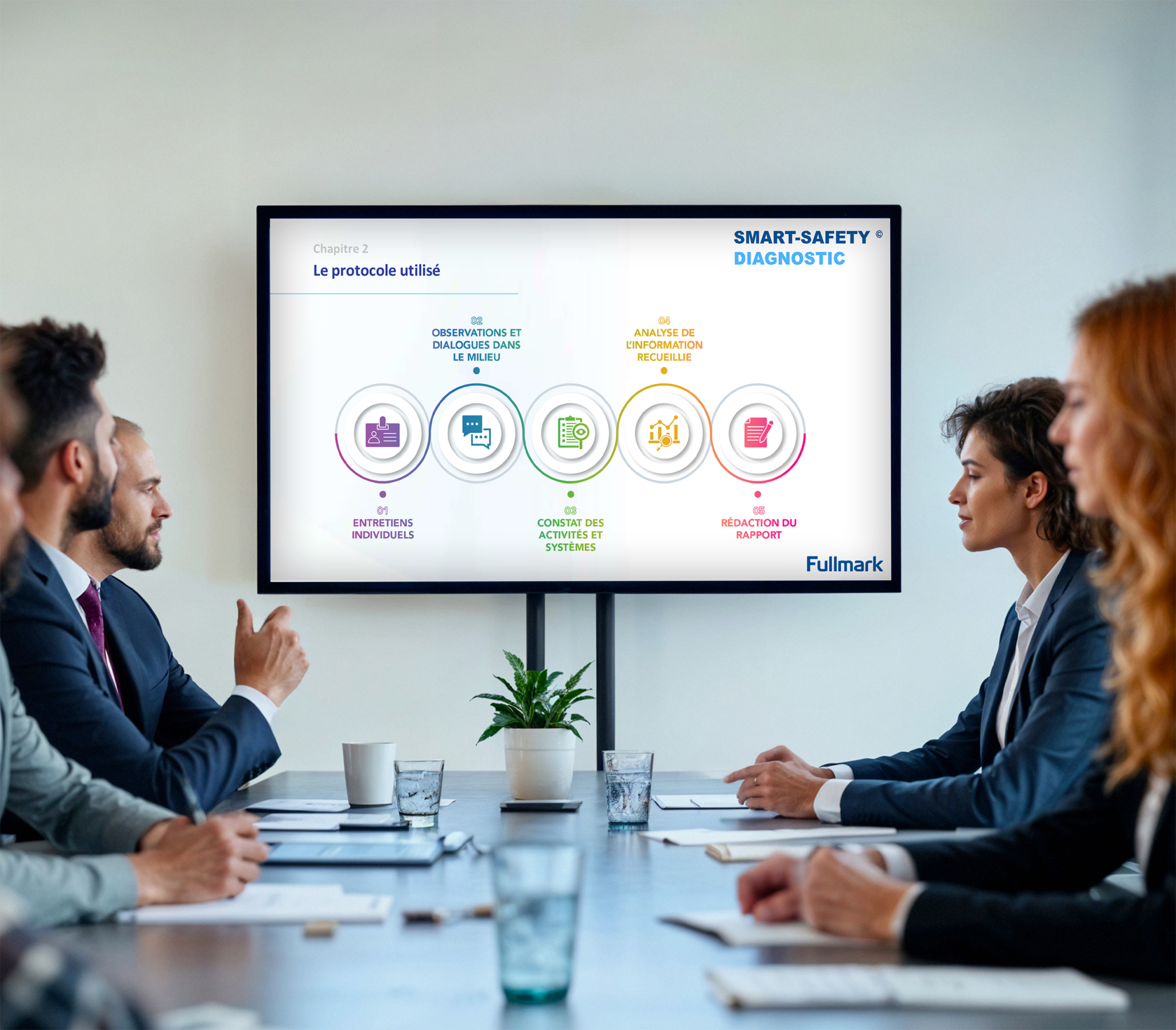
- Meeting with HSE and operational management: our expert spends a day on site to understand how your company operates in terms of safety. To do this, they will meet with the various key players in your safety culture.
- Company visit: this provides a clear understanding of operational realities and allows us to observe behaviors in the field.
- Interactive workshops: we organize several groups of around 8-10 people: a “Management” group, one or more “Supervisor” groups, and several “Employee” groups.
- Report and action plan: our meetings, the site visit, and the workshops give us a complete view of your company’s safety culture. Our expert will share with you the obstacles they identified and the possible areas for improvement. The great strength of our approach is that we don’t just make an observation—we move straight into action and provide you with a real action plan.
Solution 2:
The diagnosis with survey

This is an exclusive approach designed to give you a clear and complete picture of your safety culture.
What sets this type of diagnosis apart is that it includes an internal survey (paper or online) to help understand the organizational characteristics that positively or negatively influence employees’ relationship with safety.
The survey is a very powerful tool because it gives you real insight into what each category of people actually thinks. You may sometimes be surprised by the survey results on certain aspects.
Our expert will also carry out on-site observations to compare the results of the employee perception survey with an outside perspective. This helps examine the consistency and alignment between what people think and what they actually do.
The report will present a detailed analysis of the data collected across 5 areas. The data provided is very useful for building an action plan that truly focuses on the gaps.
The 5 areas of the diagnosis with survey

A safety culture diagnosis is not an audit!
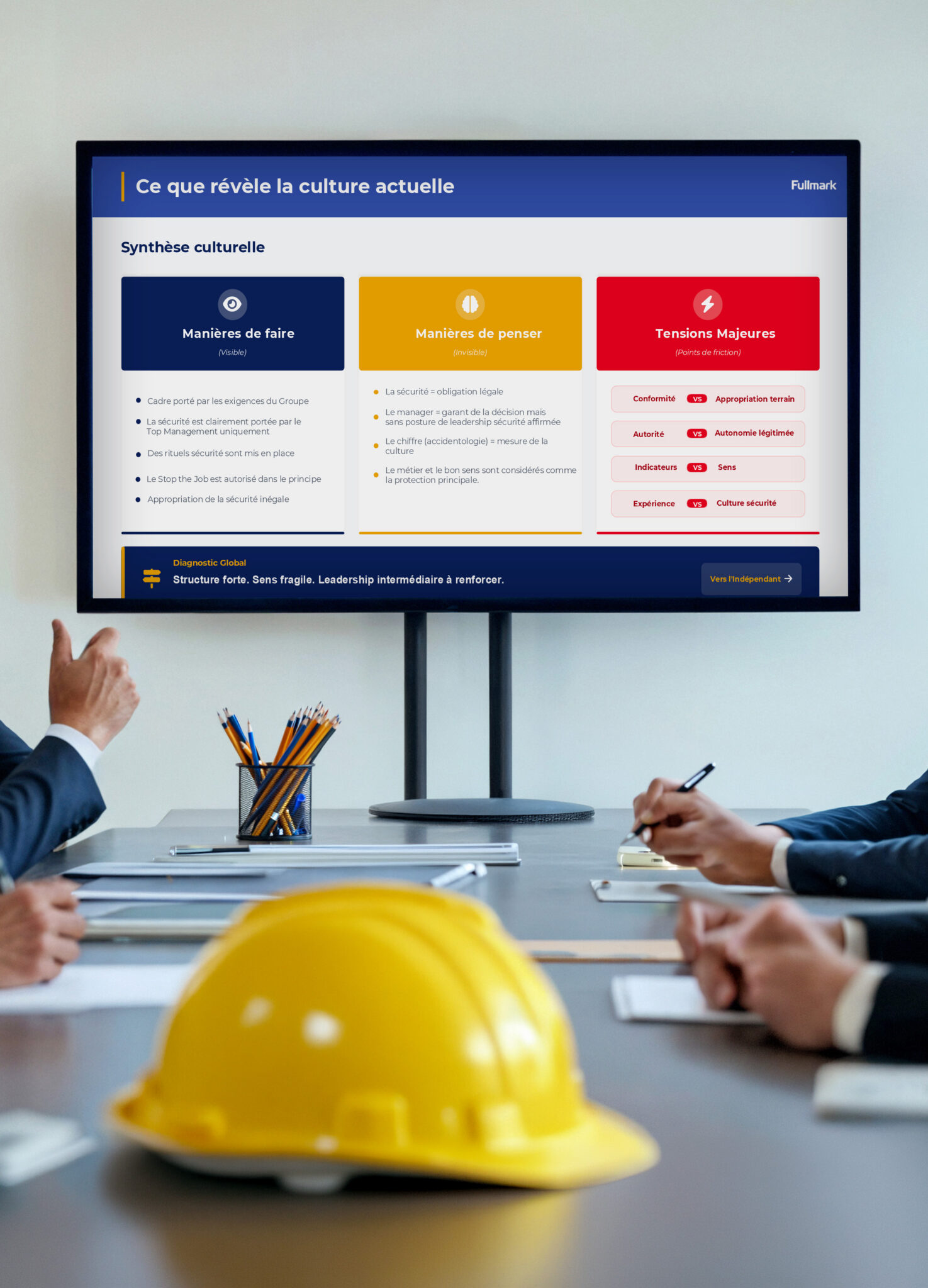
- It’s not about judging things as good or bad, like an audit that rates compliant or non-compliant. Instead, we use “feed forward,” meaning positive reinforcement. We show where you can go on a progression scale.
- The diagnosis brings to light what an audit can’t see: the gaps between what I think and what I do—the invisible part of attitudes that drive behavior.
- The diagnosis is valuable for the EHS manager and for management because it helps objectively assess the impact of everything that has been put in place in the company… since lost-time injury rates and severity rates aren’t always the best performance indicators at the SSBE level.
What are the benefits of a safety diagnosis?
Whichever option you choose, our experts help you build a strong safety culture and organization. Here are some of the benefits of our approach:
- Give meaning to and objectively assess the HSE action plan.
- Address the legal requirement to have a dynamic risk management system in place.
- Gain a shared understanding of the company’s maturity level.
- Prepare for the predictable and respond effectively to the unexpected.
- Increase the effectiveness of existing tools.
- Implement new tools.
- Build engagement.
- Embed new practices.
- Strengthen managerial closeness through concrete, visible actions on the ground.
- Guide the steering committee toward greater agility.
- Develop the skills and techniques of the management line.

What is
"safety culture" in a company?
A company’s safety culture encompasses a whole range of formal and informal aspects. Safety culture is the combination of written and unwritten rules. It identifies the behaviors that influence safety within the company.
If you want to evolve your safety culture and reduce accidents, you need to act on behavior. To succeed, it’s important to know where you’re starting from. That’s the whole point of the initial safety culture diagnosis, which identifies the current determinants of your safety culture before implementing reinforcement tools.
Second important step: determine the level of health and safety culture you want to achieve. Based on these two elements—your starting point and your goal—you can develop an action plan that is tailored, efficient, and sustainable, with positive impacts on your company’s overall performance. Fullmark’s method for success is called SMART-Safety.
5 STEPS
to developing a workplace safety culture
First and foremost, it is essential to involve both senior management and line managers on one hand, and all employees on the other. Safety is everyone's concern in the organisation. Don't leave anyone out!
It is also important to establish an agile safety climate that allows for quick changes and adaptation.
Next, workers should be encouraged to participate in all aspects of the safety programme, including reporting safety issues or suggesting ideas to make a process safer.
It is also important to identify the main risks linked to the company's activity (with particular focus on major risks) and to set clear objectives to progress along the safety culture maturity curve.
Finally, it is recommended to train staff in workplace safety and, through a well-designed prevention campaign, to display safety guidelines and best practices at work. In these areas too, you can benefit from Fullmark's extensive experience.
Ready to take stock of your safety culture with a tailored diagnosis?
Our team of consultants is available to help. Whether you’d like to learn more about our approach and the various options, request a quote, or get advice, feel free to contact us. We can quickly set up a video call or meeting with no obligation on your part.
We can tell you about the various diagnoses we’ve carried out for our clients and the benefits they’ve gained from them.


